
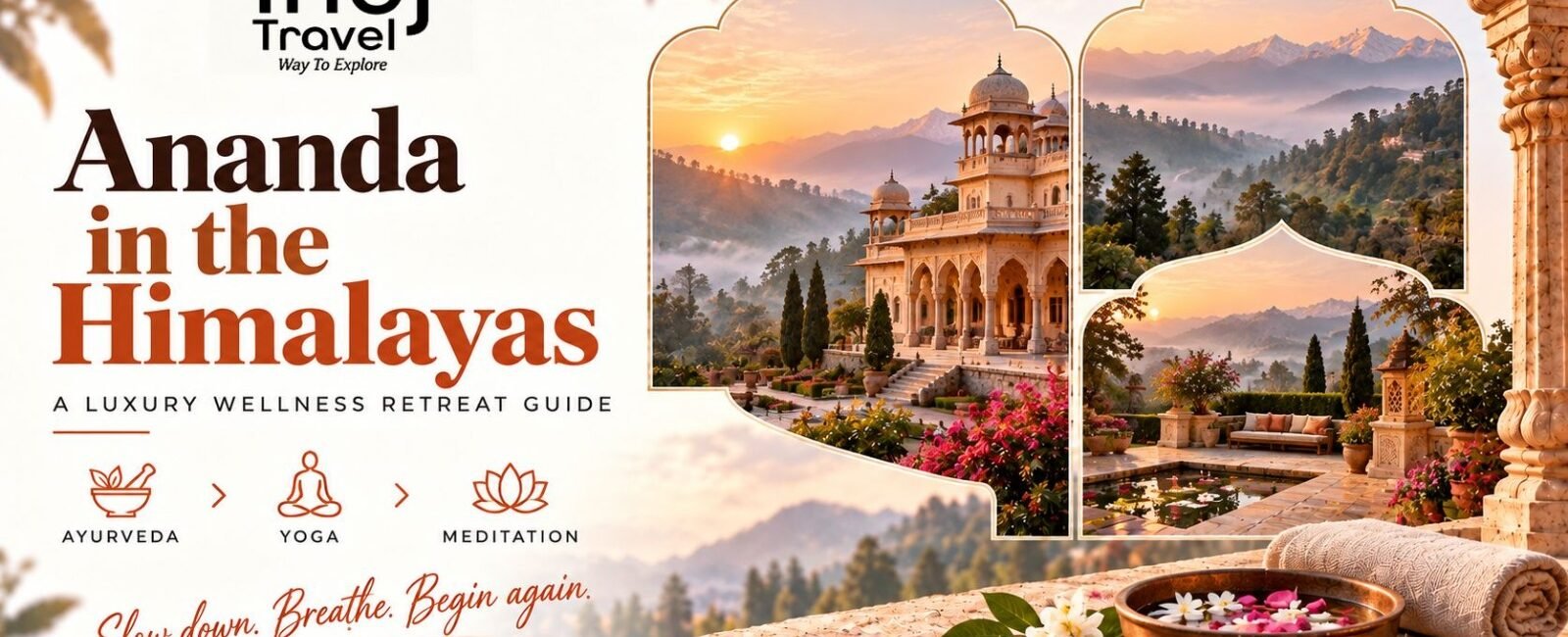
Ananda in the Himalayas: A wellness retreat beyond luxury
High in the Himalayan foothills above Rishikesh, where the air smells of sal forest and the Ganges valley spreads out below, sits a former Maharaja’s palace estate that has become one of the most awarded wellness destinations on the planet. Ananda in the Himalayas is not a hotel with a spa attached. It is a full wellness retreat built around Ayurveda, yoga and meditation, and it has spent more than two decades collecting top honours, including being ranked the number one Destination Spa in the world by Conde Nast Traveller readers. This guide covers what Ananda actually is, what a stay involves, how to get there, and how to plan it well.
Quick answer
Ananda in the Himalayas is a luxury wellness retreat on the 100-acre Palace Estate of the Maharaja of Tehri-Garhwal, near Rishikesh in Uttarakhand. Guests come for structured wellness programmes of 7, 14 or 21 nights covering Ayurveda, detox, stress management, yoga and meditation, supported by a 25,000 sq. ft. spa, dosha-based cuisine and daily guided practices. Fly Delhi to Dehradun (45 minutes), then drive about 40 to 45 minutes to the retreat.
Location, Where Is Ananda in the Himalayas Located?
Ananda sits on a hill overlooking Rishikesh, the spiritual town on the banks of the Ganges in Uttarakhand, North India. The retreat occupies the Palace Estate of the Maharaja of Tehri-Garhwal at Narendra Nagar, spread across 100 acres of grounds, gardens and surrounding forest.
The location is not incidental. This region is widely regarded as the birthplace of Ayurveda, yoga and meditation, and Rishikesh below remains one of India’s most important spiritual centres, drawing seekers from every corner of the world. The estate’s position, high enough to catch the mountain breeze and face the valley, gives it something most luxury resorts cannot manufacture: genuine quiet. The nearest airport, Jolly Grant Airport at Dehradun, is roughly 35 km away, about a 40 to 45 minute drive.
What makes it different, Why Ananda Is Not Just Another Luxury Resort
Plenty of Indian hotels market themselves as wellness retreats. Ananda’s difference is structural. Wellness is the entire operating model, not a department:
- Guests on programmes begin with a consultation with an Ayurvedic doctor, who assesses their dosha (body constitution) and designs their therapies, diet and daily routine around it.
- The retreat integrates traditional Ayurveda and yoga with international therapies, emotional healing, spiritual awareness and organic cuisine, all under one roof.
- The team includes qualified nutritionists, Western and Ayurvedic physicians, spa therapists, and yoga and fitness experts who guide guests rather than simply serve them.
- The setting does half the work: mornings open with mist in the valley, and the only sounds competing with the birdsong are the temple bells drifting up from Rishikesh.
Recognition has followed. Ananda’s awards page lists Conde Nast Traveller Readers’ Choice rankings as the number one Destination Spa in the rest of the world in the 2023 and 2024 UK editions, Favourite Destination Spa at the Conde Nast Traveller India Readers’ Travel Awards across multiple years, a Global Spa Awards win for Best Global Ayurveda Retreat in 2026, and a place on Oprah Daily’s Hotel O-Wards list of the best retreats.
In short, people do not come to Ananda for a holiday with a massage on the side. They come to reset, and the whole estate is organised around that goal.
Fit, Who Is Ananda Best For?
Ananda suits travellers who want their holiday to change something. Couples book it for restorative breaks that go deeper than a pool and a buffet. Solo travellers, who make up a large share of guests, come for structured health resets with professional supervision. Burnt-out executives arrive for the stress management and sleep programmes, and spiritual seekers treat it as a comfortable base for the Rishikesh region’s deeper pull.
It is equally honest to say who should look elsewhere. Ananda keeps retreat hours and a retreat atmosphere: quiet evenings, wellness-focused dining and early mornings. If the goal is nightlife, shopping or a resort party scene, Rishikesh’s hotels and the hill stations further north will fit better. Ananda is for people who want to return home measurably better than they left.
The Wellness Programmes
Ananda’s signature offering is its structured wellness programmes, most of which run for 7, 14 or 21 nights at comprehensive and intensive levels. Each begins with an Ayurvedic consultation and unfolds as a personalised schedule of therapies, yoga, meditation and tailored meals. The current programme menu includes:
- Ayurvedic Rejuvenation and Immunity Booster – classical Ayurvedic therapies aimed at restoring energy and resilience.
- Stress Management – for guests carrying burnout, anxiety or chronic tension.
- Holistic Detox and Yogic Detox – cleansing programmes, the latter combining Ayurvedic methods with traditional yogic purification practices.
- Panchakarma – the most intensive classical Ayurvedic cleansing protocol, supervised by doctors.
- Dhyana Meditation – a programme built around developing a real, sustainable meditation practice.
- Holistic Yoga – traditional Hatha yoga taught as a complete discipline, not a fitness class.
- Weight Management and Activ-Fitness – metabolism, movement and body composition work with detailed fitness assessment and personalised training.
- Sleep Enhancement – for guests whose primary issue is rest, an award-recognised programme.
- Renew, Hormonal Rebalance, Menstrual Health, Fertility Enhancement and Chronic Pain Management – specialist programmes for specific health goals, some requiring 14 or 21 nights.
The honest way to choose: pick the programme by the outcome you want, then let the Ayurvedic doctor adjust the details on arrival. Ananda’s reservations team can help match goals to programmes before booking.
Spa, The Spa
Ananda’s spa is the physical heart of the retreat: 25,000 square feet with around two dozen treatment rooms, including dedicated Ayurveda, international therapy and hydrotherapy rooms, plus steam, sauna, plunge pool, relaxation areas and Kneipp foot ritual facilities, along with a state of the art gymnasium and an outdoor temperature-controlled swimming pool.
The treatment menu runs to more than 80 body and beauty experiences. On one side sit traditional Ayurvedic therapies delivered by expert therapists under doctor supervision, from full-body therapeutic massages to specialised Ayurvedic diets. On the other, international experiences: aromatherapy, reflexology and pressure-point work, and healing Tibetan Kuu Nye among them. Visiting Masters run special workshops and private sessions in different areas of wellbeing throughout the year, and Vedanta talks by senior Vedic scholars address the philosophical side of the practice. The result is a spa that operates more like a clinic crossed with an ashram, wrapped in five-star comfort.
Stay, Rooms, Suites and Villas
Accommodation is split between the main building, the Viceregal Palace, and private villas in the forest:
- Deluxe Guest Rooms (45 sqm) – elegant rooms with private balconies, walk-in closets and views over the Ganges valley, the gardens or the Palace. Valley View rooms on the premium 4th, 5th and 6th floors have the widest panoramas.
- Garden Suites – bedrooms with attached lounges, large bathrooms and secluded private gardens facing either the valley or the Maharaja’s palace.
- Valley View and Garden View Suites – two-bay suites with separate living rooms; the Valley View versions are the pick for scenery.
- Viceregal Suite – set inside the Viceregal Palace itself, with a spacious sitting and dining area, antique fittings and a private terrace with spectacular views.
- Ananda Suite – a luxurious bedroom, private sitting and dining areas, and a large private garden with gazebo seating overlooking the valley.
- Ananda Villas – complete private retreats among the sal trees, each with a butler pantry, spacious bedrooms and bathrooms, and its own 40 sqm private pool, in one and two bedroom configurations.
For a first visit focused on a programme, a Valley View room is the sweet spot. For privacy, a longer stay or a special occasion, the villas are the answer.
Dining: Wellness Cuisine
Food at Ananda is part of the treatment. The wellness cuisine concept is built on Ayurvedic principles: fresh, natural, seasonal ingredients, low in fat, free of added artificial salts, colours, flavours and preservatives, and matched to your dosha. Ayurveda describes three body types, Vata, Pitta and Kapha, and the kitchen adjusts flavours and ingredients to balance whichever pattern your consultation identifies. Menus for programme guests are drawn up in consultation with the in-house Ayurvedic doctor.
The signature restaurant sits in a grove of old sal trees with a treetop deck overlooking the Rishikesh valley, serving Indian, Asian and Western menus that change with the seasons, often to the sound of classical instrumental music. The Palace Lounge handles quieter moments. There is also a culinary studio where chefs teach guests how to cook these dishes at home, which is the point: the retreat wants the benefits to survive the flight home.
Daily rhythm : A Typical Day at Ananda
Days at Ananda follow a gentle but deliberate rhythm. Based on the retreat’s own published schedule:
- 7:15 to 8:30 am – Hatha yoga, or an early nature walk and trek in the surrounding forest.
- 9:00 am – morning stretches to release muscular tension.
- 9:30 am – a Visiting Master talk on healing techniques.
- 10:00 am and 6:00 pm – Vedanta sessions with senior Vedic scholars.
- Late morning and afternoon – individual spa treatments according to your programme, fitness sessions, or rest by the pool.
- Evenings – quiet dinners, often with live classical instrumental music in the restaurant.
Nothing is compulsory, but most guests find the structure is exactly what makes the stay work.
Excursions: Experiences Beyond the Retreat
The most popular outing is the sunrise trek to Kunjapuri Temple, a sacred hilltop shrine about 13 km up the mountain with snow-capped Himalayan views. Down in Rishikesh, the evening Ganga Aarti ceremony on the riverbank is one of India’s most moving spiritual rituals. Guided nature walks and bird-watching in the sal forest round out the gentler options, and the region’s famous white-water rafting runs nearby on the Ganges for guests who want adrenaline with their enlightenment. Ask the retreat about transport when planning excursions, especially during busy pilgrimage periods.
Getting there
How to Reach Ananda in the Himalayas
- By air: fly to Jolly Grant Airport, Dehradun. Daily flights run from Delhi (about 45 minutes), with at least one flight from Mumbai, Bangalore, Hyderabad, Jaipur, Lucknow, Amritsar and Ahmedabad. The retreat is about a 40 to 45 minute drive from the airport, and transfers can be arranged.
- By train: daily trains from Delhi to Haridwar take around 4.5 hours, followed by roughly a 90-minute drive to Ananda.
- By road: the drive from Delhi takes about 5 to 6 hours depending on traffic.
- By helicopter: Ananda can arrange helicopter transfers from Delhi to its private helipad, about 2 hours of flying.
One practical note for international travellers: India requires a tourist visa for leisure travel, and most nationalities can apply online through the government’s e-visa portal before departure.
Seasons: Best Time to Visit
Ananda’s own guidance describes a moderate climate year-round, roughly 18 to 30 degrees Celsius. April to early June is warm with cooler evenings. Late June to early September is monsoon, with mostly mild showers. September and October bring bright sunny days, and November to March offers cool, clear weather with plenty of sunshine; carry a jacket from late December to mid-January.
The most popular windows are autumn (September to November) and spring (February to April), when skies are clearest and the Himalayan views are at their best. One caveat: during the Shravan month Kanwad festival (roughly late July to late August), road travel around Haridwar and Rishikesh becomes extremely congested, so plan transfers with the retreat if travelling then.
Practical Planning Notes
Check-in is at 2:00 pm and check-out at 11:00 am; if you are landing early, reserving the room from the night before guarantees morning access. Transfers from Dehradun airport or Haridwar and Dehradun railway stations can be arranged through Ananda’s reservations team when you book. Pack for walking: forest paths, the Kunjapuri trek and long, unhurried evenings outdoors are part of the experience.
FAQs
- Where exactly is Ananda in the Himalayas?
On the Palace Estate of the Maharaja of Tehri-Garhwal at Narendra Nagar, on a hill above Rishikesh in Uttarakhand, North India, about 35 km from Dehradun’s Jolly Grant Airport.
- How long should I stay at Ananda?
The signature wellness programmes run for 7, 14 or 21 nights. A week suits most first-time guests; deeper programmes such as Panchakarma or the hormonal and fertility tracks need two to three weeks.
- What does a wellness programme include?
Each programme starts with an Ayurvedic doctor consultation and dosha assessment, then combines scheduled therapies, yoga and meditation sessions, wellness activities and dosha-based meals. Exact inclusions vary by programme, so confirm details with Ananda’s reservations team.
- Is Ananda suitable for wellness beginners?
Yes. Hatha yoga classes cater to beginners and experienced practitioners alike, teachers tailor sessions to individual goals, and the doctors and nutritionists guide guests who have never followed an Ayurvedic routine before.
- How do I get to Ananda from Delhi?
The easiest route is a 45-minute flight to Dehradun’s Jolly Grant Airport followed by a 40 to 45 minute drive. Trains to Haridwar (about 4.5 hours) plus a 90-minute drive, a 5 to 6 hour road trip, or a helicopter transfer are the alternatives.
- What are the check-in and check-out times at Ananda?
Standard check-in is 2:00 pm and check-out is 11:00 am. Guests arriving on early flights can reserve the room from the previous night to guarantee immediate access.
- When is the best time to visit Ananda in the Himalayas?
September to November and February to April offer the clearest skies and most comfortable weather. Winters are cool and sunny; the monsoon (late June to early September) is lush but wet, and the Shravan festival period brings heavy road traffic nearby.
Conclusion
Ananda in the Himalayas earns its reputation the hard way: a genuine palace estate, a serious bench of doctors, teachers and therapists, and a setting that does half the healing before your first treatment begins. If you want a luxury stay with spa access, many hotels will do. If you want a structured reset rooted in the land where Ayurveda and yoga began, this is the benchmark.
