
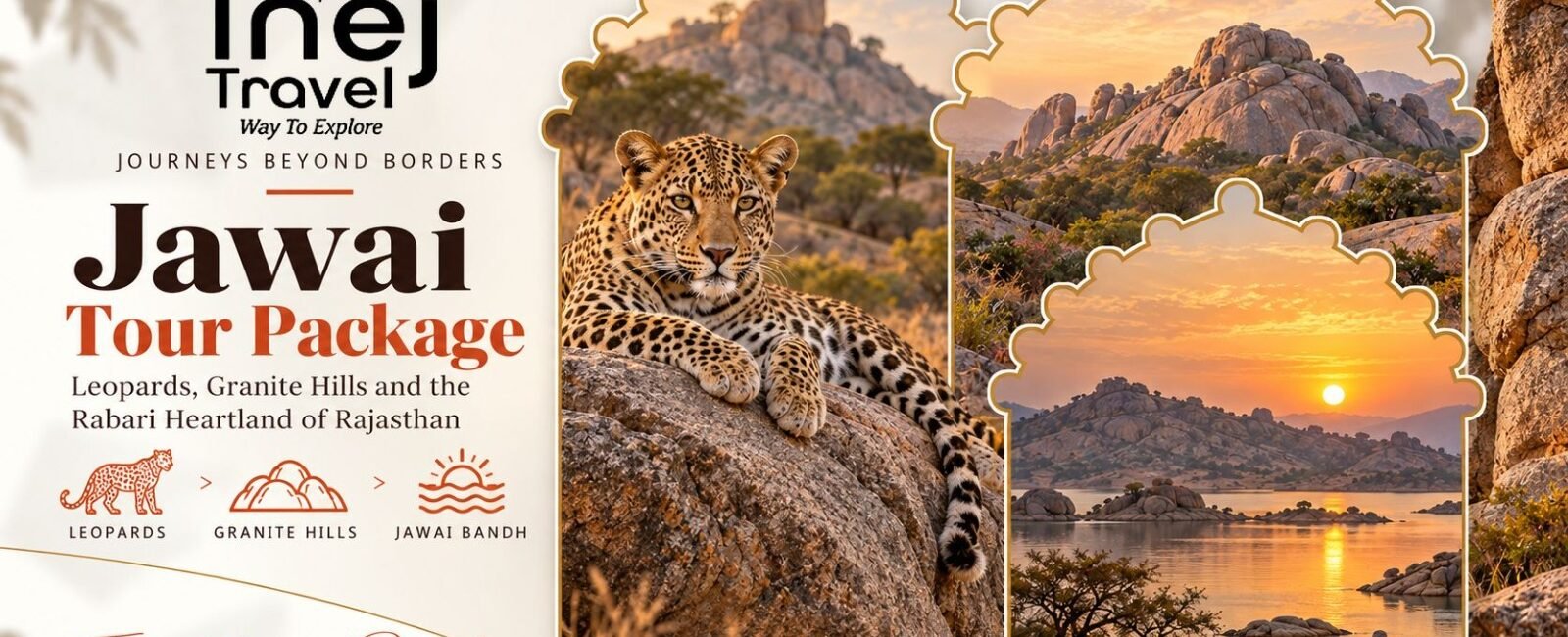
Jawai Tour Package: Leopards, Granite Hills and the Rabari Heartland of Rajasthan
By Inej Travel Pvt Ltd | Updated Nov 2026 | 15 min read
Some wildlife destinations are famous for their forests. Jawai is famous for its rocks. In this quiet corner of Pali district, Rajasthan, leopards live in caves inside billion-year-old granite hills, sharing the land with Rabari shepherds and their villages. Sightings here are so frequent that Jawai has become one of India’s most talked-about leopard destinations, without any park gates or fenced zones.
This guide walks through everything you need to plan a Jawai tour package: where Jawai is, what makes it different from every other safari in India, what a typical package includes, the leopard safari experience, the dam, birding and Rabari culture beyond the big cats, the best season to visit, how to reach, and how many days to keep for the trip. It follows the same route logic as Inej Travel’s Rajasthan Royal Diaries itinerary, which covers the Jodhpur-Jawai-Udaipur segment.
TL;DR / Quick Answer
Jawai is a leopard-safari region in Pali district, Rajasthan, built around the Jawai Bandh reservoir and a landscape of billion-year-old granite hills. It is not a fenced national park: leopards live in caves in the rocks, side by side with Rabari shepherds and their villages, which is why sightings here are famously frequent. A typical Jawai tour package runs 1 night/2 days or 2 nights/3 days, with morning and evening leopard safaris in an open 4×4 gypsy, a stay in a camp or resort near the hills, a visit to Jawai Dam, and Rajasthani meals. The best season is October to March. The nearest airports are Udaipur (about 130 km) and Jodhpur (about 160-170 km), and the nearest railway stations are Jawai Bandh, Mori Bera and Falna. Book safaris and stays in advance for December and January.
Where Exactly Is Jawai?
Jawai lies in the Pali district of western Rajasthan, roughly midway between Jodhpur and Udaipur. The region takes its name from the Jawai River, a tributary of the Luni, and from the Jawai Bandh – the dam built across the river near Sumerpur. Completed in 1956-57 under Maharaja Umaid Singh of Jodhpur, it is described as the largest dam in western Rajasthan, and its reservoir is the reason the area has water, birds and mugger crocodiles year-round.
What makes the landscape instantly recognisable is the rock. Jawai sits in the ancient Aravalli range, and its hills are giant rounded granite formations, weathered into boulders, caves and ledges over an immense span of time. Those caves are natural leopard dens, which is the whole secret of the place: the cats never needed a forest, because the granite gives them shelter, vantage points and camouflage in one package.
The main safari zones sit around villages such as Bera and Sena, and most camps, lodges and resorts are scattered within a short drive of the dam and the hills.
Why Jawai Is Unlike Any Other Safari in India
Every other famous leopard or tiger destination in India is a protected national park or sanctuary with gates, zones and forest department rules. Jawai is different. It is a living, working landscape – farmland, grazing commons, villages and hill temples – where leopards have coexisted with people for generations.
The Rabari (Raika) community, the pastoral herders of this region, treat the leopard as a guardian of the hills and their temples, and livestock losses are traditionally absorbed or compensated rather than avenged. The result is one of the most remarkable wildlife stories in India: leopards here are bold enough to rest on rocks in open view, above active villages, and conflict with humans is strikingly rare.
For a traveller, that translates into three practical differences:
- No park gates or fixed zones. Safaris are community-led drives in private open-top 4×4 gypsies, guided by local trackers – many of them Rabari herders turned naturalists – who know individual leopards and their favourite ledges.
- High sighting probability. Jawai’s leopard density is among the highest reported in India, and sightings on the rocks are frequent. They are wild animals, so no sighting is ever guaranteed – but two safaris, one at dusk and one at dawn, give most visitors a strong chance.
- Culture and wildlife in one trip. A Jawai tour package rarely means only game drives. Village visits, hilltop temples, birding at the dam and Rajasthani food around a bonfire are part of the standard experience.
What Does a Jawai Tour Package Usually Include?
Packages vary by operator and by the standard of stay, but the common building blocks look like this:
- Stay: 1 or 2 nights in a luxury tent, cottage or resort room near the hills or the dam. Options range from comfortable mid-range camps to celebrated luxury wilderness lodges.
- Safaris: Two leopard safaris are the heart of most packages – typically an evening drive on arrival day and a sunrise drive the next morning, in a private or shared 4×4 gypsy with a driver-tracker.
- Meals: Most camps include breakfast and dinner, often with rooftop or lakeside dining, a bonfire in winter, and traditional Rajasthani dishes.
- Add-on experiences: A Jawai Dam and birding drive, a Rabari village visit, hilltop high tea at sunset, and nature walks are common inclusions or easy add-ons.
On cost: safari prices are usually quoted per gypsy (seating up to about six guests) rather than per person, and published rates from local operators generally fall in the ₹4500-6,500 range per safari depending on the season and inclusions. Full package prices depend heavily on the stay category, so always confirm what is included – number of safaris, meals, transfers – before comparing quotes. Jawai also appears as a 2-night segment inside longer Rajasthan itineraries, for example combined with Jodhpur and Udaipur.
The Leopard Safari Experience
Safaris run twice a day, timed to when leopards are most active:
- Morning safari: roughly 5:00-8:00 AM in summer and 6:00-9:00 AM in winter. After a cold night, leopards often come out to bask on sun-warmed rock, and the soft early light is beautiful for photography.
- Evening safari: roughly 4:00-7:00 PM (a little earlier in winter). As the heat leaves the granite, leopards move toward their favourite ledges, and the drive ends in golden-hour light over the hills – the classic Jawai scene, often rounded off with high tea on a hilltop.
A safari lasts about 2.5 to 3.5 hours. The gypsy climbs between villages and rock outcrops while the tracker reads pugmarks, alarm calls and fresh knowledge of where specific cats were last seen. Leopards are the headline, but keep your eyes open for striped hyenas, jungle cats, desert and Bengal foxes, nilgai (blue bull), and sloth bears, all of which are recorded in the Jawai landscape.
A few etiquette points that matter here more than anywhere: stay seated, keep voices low, never pressure the driver to close distance, and skip flash photography. Jawai’s leopards tolerate vehicles because generations of drivers and villagers have kept the experience calm – that tolerance is the product.
Beyond Leopards: Jawai Dam, Birding and Crocodiles
The Jawai Bandh reservoir deserves a morning of its own. The dam’s vantage points look over open water where mugger crocodiles bask on the banks, and in winter the reservoir fills with migratory birds – flamingos, demoiselle cranes, bar-headed geese, pelicans and a long list of waders and waterfowl. Resident species, from kingfishers and green bee-eaters to the Indian eagle-owl, keep birders busy year-round; some lodges report well over 200 bird species in the region.
A typical package folds this in as a relaxed post-breakfast drive: dam viewpoints, crocodile spotting, and birding, often combined with a village stop on the way back.
The Rabari Villages and Hill Temples
Ask anyone who has been to Jawai what stayed with them, and half will say the people. The Rabari herders – the men in white with brilliant red turbans, moving flocks of sheep, goats and camels across the scrub – are central to why this landscape works. A village visit, arranged respectfully through your camp, is a window into a pastoral way of life that has changed little in generations.
The hills are dotted with small temples and shrines, some of them centuries old, and many safari routes pause at one – a leopard resting below a temple wall is one of Jawai’s signature images. These are active places of worship, so dress and behave accordingly.
Best Time to Visit Jawai
Jawai is open all year – it is not a park with a closing season – but the experience changes with the calendar:
- October to March (peak season): Pleasant days and cool to cold mornings, roughly 10-25°C. The most comfortable safari weather, the best light, peak migratory birdlife at the dam, and leopards basking on the rocks after cold nights. December and January are the busiest weeks – book stays and safaris one to two weeks ahead.
- April to June (summer): Hot, with afternoons often above 40°C, and drives kept to dawn and dusk. The reward: vegetation is thin and leopards stay close to water, so sightings can be excellent for those who can handle the heat.
- July to September (monsoon): The granite hills turn green and the skies are dramatic. Fewer visitors and beautiful landscapes, but rain can disrupt drives and thicker cover makes leopards harder to spot.
For a first visit, November to February is the sweet spot; October and March offer similar rewards with thinner crowds.
How to Reach Jawai
Jawai has no airport of its own, but it sits conveniently between two of Rajasthan’s best-connected cities:
- By air: Udaipur’s Maharana Pratap Airport is about 130 km away (around 2.5 hours by road), and Jodhpur Airport is about 160-170 km (roughly 2.5-3 hours). Both have daily flights from Delhi and Mumbai. Ahmedabad, about 280 km away, is another option.
- By train: The nearest stations are Jawai Bandh, Mori Bera and Falna, all on the Delhi-Ahmedabad-Mumbai broad-gauge line, with connections from Jaipur, Delhi, Mumbai and Ahmedabad. Falna is roughly 30 minutes from the main camp area.
- By road: Jawai is about 150 km from Jodhpur (around 3 hours) and 160-180 km from Udaipur (around 3 hours). Most packages include or can arrange private transfers from either city, and Jawai combines naturally with Ranakpur, Kumbhalgarh (about 100 km) or Mount Abu (about 120 km) on a longer Rajasthan route.
How Many Days Do You Need in Jawai?
One night and two days is the classic minimum: arrive by afternoon, take the evening safari, sleep at the camp, take the sunrise safari, and visit the dam before leaving. It works because two safaris give you two separate chances at leopards.
Two nights and three days is what most wildlife lovers and photographers choose. The extra day means three or four drives, time for birding at the dam, a village visit and a slow evening around the bonfire without watching the clock. Serious photographers often stay longer, because more drives mean more encounters and better light.
A simple 2-day framework looks like this:
- Day 1: Arrive from Udaipur or Jodhpur by early afternoon, check in, evening leopard safari with sunset high tea, dinner at the camp.
- Day 2: Sunrise leopard safari, breakfast, Jawai Dam birding and crocodile drive or a Rabari village visit, departure by early afternoon.
What to Pack and Practical Tips
- Layers for winter: November to January mornings in an open gypsy are genuinely cold – carry a warm jacket, beanie and gloves even when afternoons are mild.
- Neutral colours: Earthy clothing keeps you inconspicuous and dust-friendly.
- Camera kit: A zoom lens in the 200-400mm range, spare batteries and memory cards; charging points can be limited at camps.
- Sun protection: Sunglasses, a hat and sunscreen are essential most of the year, plus water and any personal medication.
- Booking discipline: Safari gypsies are limited in number. For December, January, long weekends and festival dates, confirm your stay and both safaris before you travel.
- Realistic expectations: Jawai’s sighting record is excellent, but these are wild leopards. Treat every sighting as a gift, not a guarantee, and the trip will never disappoint.
Combining Jawai with the Rest of Rajasthan
Jawai slots beautifully into a wider Rajasthan itinerary. The most natural pairings are Udaipur (City Palace, Lake Pichola) and Jodhpur (Mehrangarh Fort, the blue city), each about 2.5-3 hours away, with the exquisite Ranakpur Jain temples and the mighty Kumbhalgarh Fort lying almost on the road between them. Longer curated routes often run Delhi-Jodhpur-Jawai-Udaipur-Jaipur and onward to Ranthambore and Agra, using Jawai as the wild heart of the trip between the two great cities of the region.
Frequently Asked Questions
Q1. What is Jawai famous for?
Jawai is famous for its leopards, which live in caves in ancient granite hills and are frequently seen resting on the rocks in open view. The region is equally known for the Jawai Bandh reservoir, its winter migratory birds and mugger crocodiles, and the peaceful coexistence between leopards and the local Rabari shepherd community.
Q2. Is a leopard sighting guaranteed on a Jawai safari?
No sighting of a wild animal can be guaranteed, but Jawai has one of the highest leopard densities reported in India and a strong sighting record. Booking two safaris – one at dusk and one at dawn – gives most visitors a very good chance.
Q3. What is the best time to visit Jawai?
October to March, when the weather is pleasant (roughly 10-25°C), migratory birds fill the dam, and leopards bask on the rocks after cold nights. Summer (April-June) is hot but can deliver excellent sightings near water; the monsoon months are green, quiet and occasionally rain-disrupted.
Q4. How many days are enough for a Jawai tour package?
One night and two days is enough for a first taste – two safaris plus the dam. Two nights and three days is the recommended package for wildlife lovers and photographers, adding more drives, birding and a village experience.
Q5. How do I reach Jawai?
Fly to Udaipur (about 130 km) or Jodhpur (about 160-170 km) and drive 2.5-3 hours, or take a train to Jawai Bandh, Mori Bera or Falna station on the Delhi-Ahmedabad line. Most camps arrange transfers from either city.
Q6. How much does a Jawai leopard safari cost?
Local operators generally publish rates of roughly ₹4,500-6,500 per gypsy per safari (seating up to about six guests), varying by season and inclusions. Package prices depend on the stay category and what is bundled – confirm the number of safaris, meals and transfers included before booking.
Q7. Is Jawai safe, given that leopards live among villages?
Yes. Jawai’s leopards and the Rabari community have coexisted peacefully for generations, and incidents involving people are strikingly rare. On safari, follow your tracker’s instructions: stay seated, keep quiet, never feed or approach wildlife, and avoid flash photography.
Note: This article reflects information published by Inej Travel Pvt Ltd on inejtravel.com at the time of writing. Train schedules, packages, and pricing may change; please contact Inej Travel directly for current availability and booking details.
© 2026 Inej Travel Pvt Ltd • inejtravel.com • A-19, FIEE Complex, Okhla Phase 2, New Delhi 110020 • +91 8447 273005
